

👋 Welcome back.
Most teams I work with aren’t short on test ideas.
They have backlogs. Hypotheses. Roadmaps full of experiments.
They’re shipping A/B tests every week.
And yet — when you zoom out — it’s hard to answer a simple question:
What are we actually learning?

That’s the gap.
Running tests isn’t the same as running a program.
Tests answer isolated questions.
Programs build structured learning that compounds into strategic advantage.
If your experiments don’t clearly connect all the way up to P&L impact, you don’t have a program.
You have activity.
In this newsletter, I’ll share the simple mental model I use to turn disconnected tests into a coherent experimentation program: one where every experiment is part of a larger decision thread that actually shapes the business.

The Learning Spine
When I join a team, regardless of how mature they are, the first thing I look for is what I call The Learning Spine.
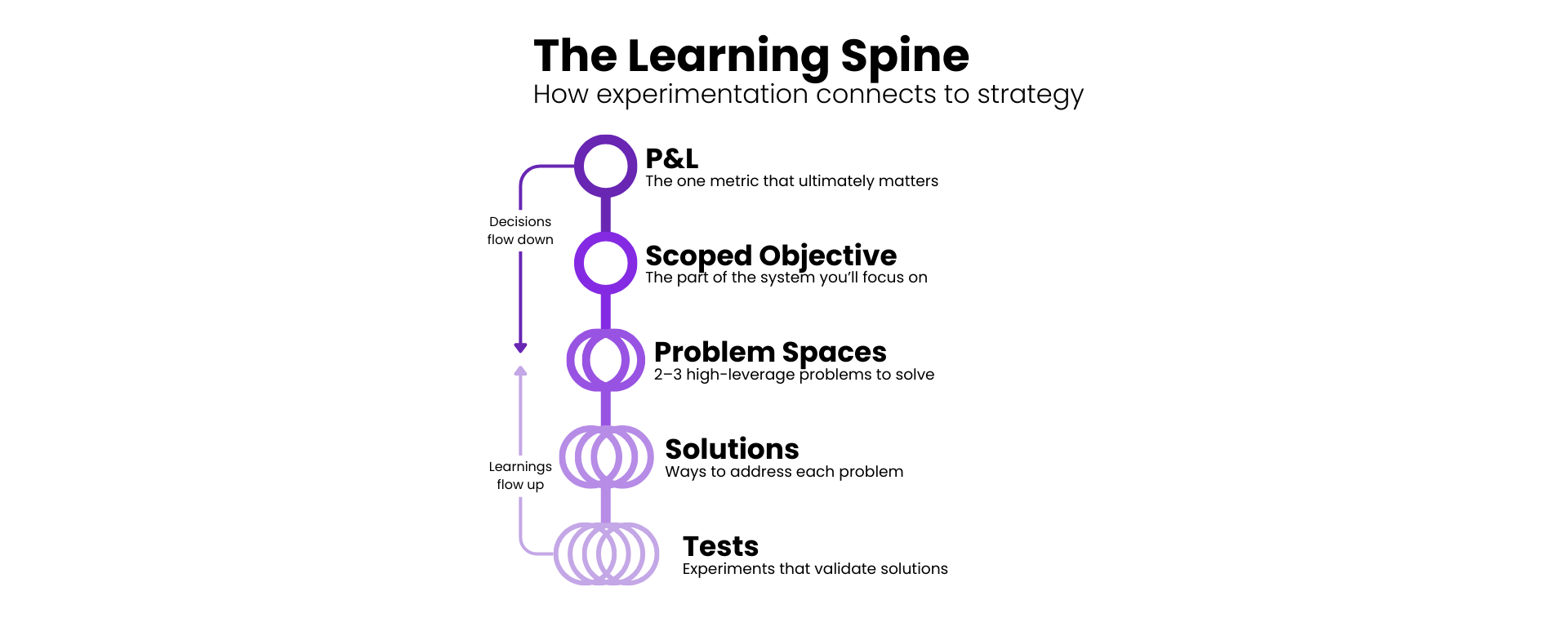
The Learning Spine is the chain of logic that connects every single experiment all the way up to the P&L.
It looks like this:
1× P&L → 1× Scoped Objective → 2–3 Problem Spaces → Many Solutions → Many Tests
Simple.
But most teams don’t actually operate this way.
Let’s break it down.
1️⃣ Start with the P&L
At the very top, there should be one clear thing you’re trying to move.
Revenue.
Gross margin.
Customer lifetime value.
Not five things. One.
If you can’t clearly articulate what line on the P&L you’re trying to influence, your experimentation program is already drifting.
This is where many teams go wrong. They start with “ideas” instead of outcomes.
2️⃣ Define a Scoped Objective
Next, define the part of the system you’re going to work on.
For example:
Customer acquisition
Activation
Subscription conversion
Retention
This is usually where your North Star or primary metric lives.
It’s specific enough to focus effort but clearly connected upward to the P&L.
Without this layer, teams jump straight from “revenue” to “let’s test button colours.” The gap in between is usually too wide to bridge and where most programs fall apart.
3️⃣ Prioritise 2–3 Problem Spaces
Now it gets interesting.
Within your scoped objective, you identify a small number of meaningful problems or opportunities to work on.
For example:
We believe we’re attracting low-intent traffic through paid channels.
We believe customers are confused in the payment flow.
We believe first-time users don’t experience value quickly enough.
These are not solutions. They’re hypotheses about where value is leaking.
This step forces alignment and focus.
It also makes it easy to say no to random ideas that don’t clearly address one of these spaces.
You’re not saying “no” to everything else forever. Just creating focus right now.
4️⃣ Generate Many Solutions
Only now do typical “experiment ideas” enter the conversation.
For each problem space, you generate multiple potential solutions.
For example:
“Making the subscribe button more visible will reduce confusion and improve conversion.”
Crucially, every solution should explicitly link upward:
Doing [solution] will address [problem], which will improve [scoped objective], which will move [P&L metric].
When that chain isn’t clear, the test probably shouldn’t exist.
5️⃣ Run Many Tests
Finally, you implement and test those solutions.
Often, one solution can generate multiple tests:
Larger button
Different colour contrast
Alternate copy
Different placement
Now something powerful happens.
Tests stop being isolated events.
They become evidence against a clearly defined problem space.
And that’s where compounding begins.
The Learning Spine structure does three things at once:
It accelerates ideation (because the boundaries are clear)
It simplifies reporting (because every test has context)
It enables strategic learning (because failure tells you when to pivot up a level)
Without it, you just have tests.
With it, you have a program.
Leveraging The Learning Spine
Structure is useful.
But its real power shows up over time.
Let’s take a concrete example.
Imagine your P&L focus is Revenue.
You’ve scoped your objective to Subscription Conversion.
You’ve identified two priority problem spaces:
Customers are confused in the payment flow
Customers don’t perceive enough value before being asked to subscribe
Let’s focus on the first one.
Step 1: Multiple Tests Within One Solution
You hypothesise that customers are confused because the “Subscribe” button isn’t clear enough.
So you test:
Making the button larger
Increasing contrast
Changing the copy
Repositioning it
Three or four tests later… nothing meaningful moves.
This is where most teams either:
Keep tweaking micro-details forever
Or abandon experimentation entirely
But with The Learning Spine in place, the response is obvious:
It’s probably not a button problem.
You pivot to a new solution inside the same problem space.
Step 2: Multiple Solutions Within One Problem
Next, you test:
Simplifying the pricing explanation
Reducing the number of plan options
Adding testimonials
Introducing a free trial
If three to five well-thought-out solutions fail to meaningfully move conversion…
Now the evidence is stronger.
It’s probably not a “payment confusion” problem.
You move up a level.
Step 3: Pivot the Problem Space
You shift focus to the second problem:
Customers don’t experience value early enough.
Now you test onboarding changes instead.
This is where structure turns experimentation into a program.
Because failure isn’t random.
It’s directional.
It tells you when to pivot up a level.
The 3–5 Rule
I often suggest teams think in terms of small clusters:
3–5 tests fail → change solution
3–5 solutions fail → change problem
3–5 problems fail → reconsider your objective
This doesn’t need to be rigid.
It just forces you to ask:
Are we learning at the right level?
On the flip side:
If 3–5 tests within a solution succeed → double down
If a problem space consistently produces wins → prioritise it harder
That’s how advantage compounds.
Why The Learning Spine Matters
Without structure:
Tests fail randomly
Wins feel isolated
Reporting feels scattered
Learning doesn’t accumulate
You get motion but not momentum.
With The Learning Spine in place:
Failure becomes directional
Success becomes scalable
Decisions get easier
Reporting becomes strategic
Leaders see progress, not just activity
Most importantly, your testing becomes a structured program generating strategic advantage.
A Simple Starting Point
As a quick exercise, take your last 10 experiments.
Can you clearly map each one up through:
A defined solution
A clear problem space
A scoped objective
A single P&L driver
If not, that’s your starting point.
Because when every test sits on the Learning Spine, experimentation stops being random.
It becomes directional.
It becomes cumulative.
It becomes a program.
Until next time 🙌
Simon
linkedin.com/in/drsimonj
Some of my other resources you might find useful:
🧮 The Experimenter’s Calculator: a tool to plan high-quality experiments
📊 Intro to A/B Test Statistics: a free webinar for practitioners